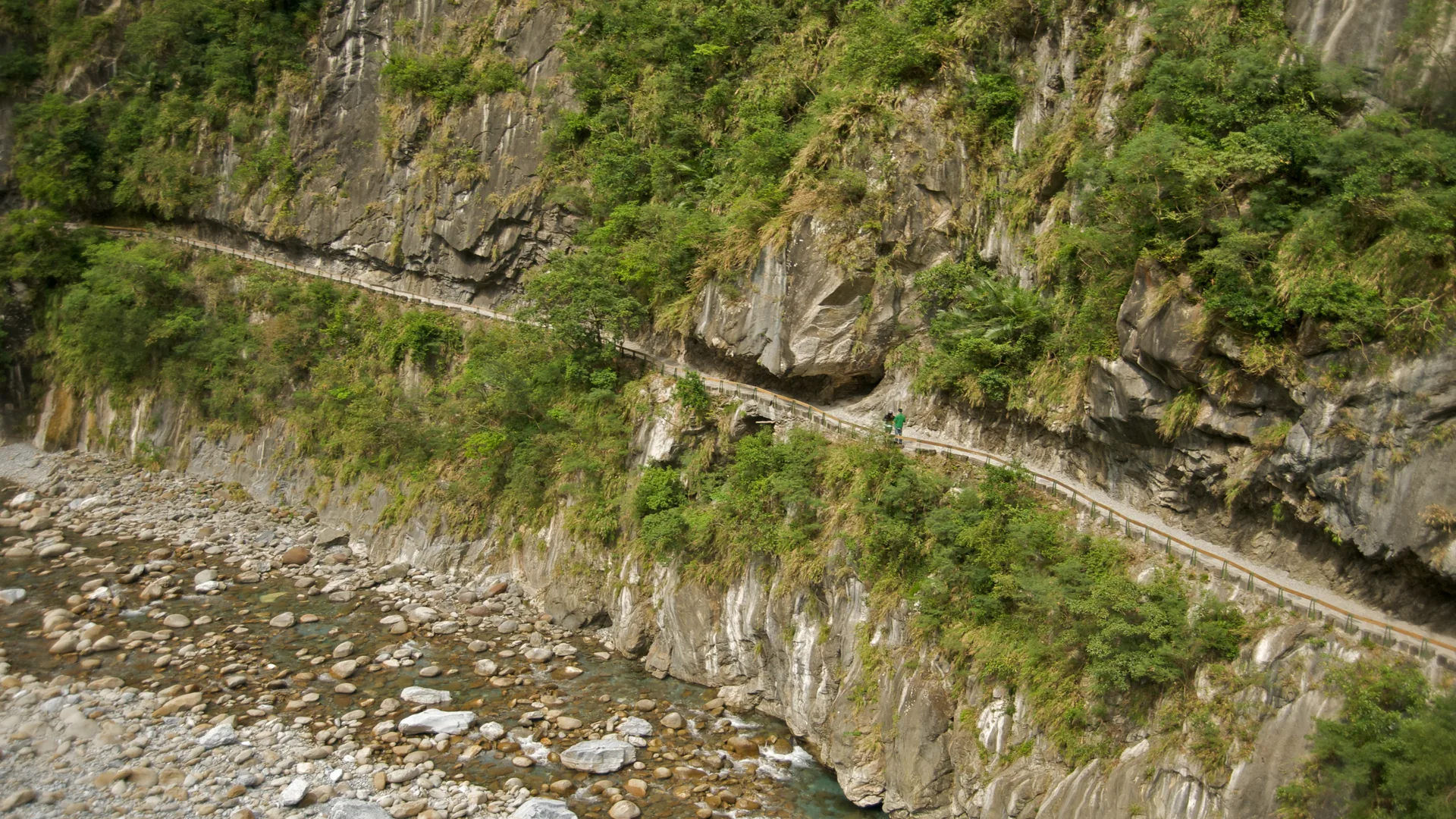
The marble canyon
Why it's marble, and why that matters
Taroko Gorge sits in a band of marble — limestone that was compressed and metamorphosed over millions of years as the Philippine Sea Plate collided with the Eurasian Plate, pushing Taiwan's central mountains up in the process. The Liwu River then cut down through that marble over a very long time as the land kept rising, and because marble erodes into smooth, sheer faces rather than crumbling scree, the gorge walls stay near-vertical instead of slumping into a gentle valley. That's the whole visual signature of the place: white-and-grey rock, rising straight up from a river running a bright turquoise.
A living, moving landscape — not a static monument
It's worth saying plainly, because it changes how you should plan the day: Taroko is not a finished, stable structure like a palace or a ruin. It's an active seismic zone with a young, still-rising mountain range, and the marble walls shed rock regularly — long before 2024, sections of trail were already closed periodically after heavy rain or minor tremors. The April 2024 earthquake was a severe version of a risk that's always been part of visiting Taroko, and the park's slow, staged reopening since then reflects genuine geotechnical assessment of unstable rock faces, not bureaucratic caution.
What most visitors are actually here to see
For a typical day visitor, "seeing Taroko Gorge" means a short list of specific, named spots strung along the gorge road and its side trails — narrow chasms where you can touch both walls, a river of turquoise water far below a suspension bridge, a temple built into a cliff face, a shrine reached by a walkway carved into rock. Which of those specific spots are actually open on the day you visit is the single most important planning question, and it's covered plainly in the next section rather than assumed.
The gorge trails
The gorge trails: which are open, which to walk
Taroko National Park suffered severe rockfall damage in the magnitude-7.2 Hualien earthquake of 3 April 2024, and as of mid-2026 it remains a partial reopening rather than a fully restored park. Status changes as engineers clear and stabilise more sections, so treat this as a snapshot to plan around, not a guarantee — check the park authority's site or your tour operator the week you travel.
Swallow Grotto (Yanzikou)
The narrow, tunnel-linked chasm that's the single most-photographed stretch of the gorge is open only in two short end sections, with the middle closed for serious damage. The park director said in March 2026 that the trail would not be repaired until 2031.
Tunnel of Nine Turns & Zhuilu Old Trail
The park director said in March 2026 that the Tunnel of Nine Turns would reopen later this year, so check the park's current notices. We found no official reopening date for the Zhuilu Old Trail.
Shakadang Trail, Baiyang / Water Curtain Cave, Eternal Spring Shrine, Buluowan
The Shakadang Trail is still closed, and the park director said in March 2026 that Shakadang and Baiyang would not be repaired until 2031. The Eternal Spring Shrine trail will not reopen before 2029, and Buluowan was due to reopen later in 2026, so check current notices.
Taroko Gate, Visitor Centre & Tianxiang area
The park entrance, visitor centre and the Tianxiang recreation area further up the gorge road remain accessible, along with lower-grade trails such as Chongde and the Taroko Terrace Trail — this is the core of what a realistic 2026 day tour actually shows you.
A day tour built around 2026 conditions leans on the gorge road itself, the sections above that are open, and stops outside the worst-affected zone (coastal viewpoints, temples, the park gate) rather than promising the pre-2024 "greatest hits" list — a straight-talking operator will say this upfront rather than let you find out on the day.
Getting in
Getting in: day tour from Hualien vs Taipei vs scooter
There are three realistic ways to see Taroko in a day, and they trade off travel time, flexibility and how well you can navigate the current road restrictions.
Shortest, most efficient
Day tour from Hualien
If you're already staying in Hualien City (a two-hour express train from Taipei), a Hualien-based day tour is the shortest way in — typically 7–8 hours door to door, with hotel pickup and a driver who already knows today's Highway 8 traffic control and which stops are open. This is the base option most Hualien-based tours, including the one on this page, are built around.
Longer, but no need to change hotels
Day tour from Taipei
Taipei-based day tours add the return high-speed or express rail journey (roughly two hours each way) to the same gorge itinerary, turning it into a 12-hour-plus day with an early start and a late return. It suits visitors who don't want to book a Hualien hotel just for one day, at the cost of a much longer day and less slack if the road windows or weather shift the schedule.
Most flexible, most homework
Self-drive scooter or car from Hualien
Renting a scooter or car in Hualien and driving in yourself is possible and gives you full control of pacing, but you're now the one responsible for knowing the day's Highway 8 traffic-control periods, current trail and road closures, and any rockfall alerts — information a local guide tracks daily as part of the job. It suits confident independent travellers more than a first-time visitor trying to parse Chinese-language road notices on the fly.
Ways to see Taroko Gorge
Find a Taroko Gorge day tour for your dates
Tap any option below and you're routed to GetYourGuide's own booking system, where you can check dates and see the total in your own currency before you pay.
Rockfall & safety
Rockfall, helmets & safety
Rockfall is the defining risk, not a remote one
Taroko's marble walls shed rock in ordinary conditions — after rain, after minor tremors, sometimes with no obvious trigger at all — and the April 2024 earthquake demonstrated how severe that risk can get when a major quake hits a gorge this steep. This isn't a hypothetical disclaimer: it's the actual reason specific trails are closed right now, and it's why the park authority controls access to higher-risk sections rather than leaving them permanently open.
Helmets, where they're used
In the narrowest, tallest-walled sections of the gorge — Swallow Grotto historically being the clearest example — visitors have long been advised or required to wear a hard hat, and the park urges visitors to wear hard hats and watch for rockfall at all times after heavy rain. Where those sections reopen in a limited or escorted form, expect the same precaution to apply; a reputable guided tour will have helmets sorted as part of the itinerary rather than leaving you to source your own.
What sensible caution looks like on the day
Stick to marked paths and open sections, don't linger directly under overhanging rock faces even where a trail is officially open, and treat any barrier, tape or closed gate as final rather than a suggestion — Taroko's closures exist because of real assessed risk, not overcaution. If you're driving yourself, listen for and respect any loudspeaker or signage warning of falling rock and don't stop under cliff faces to take photos.
When to go
When to go
Dry season vs wet season
Rockfall risk follows the weather. The park's own guidance says it rises after sudden rain following several hot, sunny days and after long spells of heavy rain, so a bright morning does not tell the whole story. Check the forecast and the park's notices the week you go, and allow for short delays after heavy rain.
Typhoon season
Typhoons and heavy rain have repeatedly damaged the gorge road since the earthquake: 28 areas of it were affected in total once nine typhoons and heavy rains over two years were counted. If a storm is forecast for your dates, build a spare day into your itinerary rather than scheduling Taroko as your only full day in the region.
Crowds and timing within the day
Taiwanese domestic holidays (Lunar New Year, national day long weekends) bring the heaviest local crowds and the tightest competition for hotel rooms in Hualien; outside those windows, Taroko doesn't have the kind of hard sell-out risk a timed museum ticket does. Within a single day, an early departure matters more than the calendar — an early start gives a guided tour the best shot at hitting every currently-open stop before afternoon traffic and light change.
GEO/FAQ
Taroko Gorge questions
Is Taroko Gorge open in 2026?
Yes. The visitor centre, the Tianxiang area, the Chongde and Dacingshui recreation areas and several trails are open, and the gorge road is a highlight in itself. Shakadang is still closed after the April 2024 earthquake, and Swallow Grotto is open in part at most; the park director said in March 2026 that both would not be repaired until 2031. A day tour is built around what is open, so check the park's site or your operator the week you travel.
What actually happened to Taroko Gorge in 2024?
A magnitude 7.2 earthquake struck near Hualien on 3 April 2024, causing rockfalls and slope failures through the gorge. Trails were severely damaged or destroyed. The park has been reopening in stages since, starting with the areas that can be made safe.
Do I need a helmet to visit Taroko Gorge?
After heavy rain the park urges visitors to wear hard hats and watch for rockfall at all times, and the narrowest stretches of the gorge are where that matters most. Ask your tour operator whether helmets are provided, and wear one wherever the park asks.
Should I book a day tour from Hualien or from Taipei?
From Hualien is shorter and more efficient — typically 7–8 hours door to door — and suits anyone already staying there or planning to. From Taipei adds a roughly two-hour rail journey each way, turning it into a 12-hour-plus day, but saves you booking a separate Hualien hotel. Neither is objectively better; it depends whether you're passing through Hualien anyway.
Can I just rent a scooter and see Taroko Gorge myself?
Yes, and it's the most flexible option, but you take on the job a guide normally does: tracking the day's Highway 8 release windows, current trail and road closures, and any rockfall alerts, much of which is posted in Chinese. It suits confident independent travellers more than a first visit where you'd rather have someone else handle the logistics.
What is Highway 8's timed access, and why does it matter?
Highway 8 through the gorge is open, but repairs are still in progress and traffic control can apply, so waits are possible. By the end of 2025, five road sites were still under construction, including four tunnels due to be repaired by July 2028. Guides plan around the road, which is one practical reason to take a tour.
What's the best time of year to visit Taroko Gorge?
Whenever you go, start early and watch the weather. The park says rockfall risk rises after sudden rain following several hot, sunny days and after long spells of heavy rain, and storms can damage the gorge road. If a storm is forecast, keep a spare day. Taroko does not need a timed ticket the way a museum does, so an early start matters more than the exact date.
Will I pay exactly what's shown, and where does the booking happen?
Yes — GetYourGuide's checkout converts the total into your own currency and lays out that departure's cancellation terms before you confirm, so nothing changes between what you see and what you're charged. We publish route and trail information for Taroko Gorge; we don't run the tours or manage the park, and GetYourGuide processes the payment itself.